Virsa Labs Marketing » Paid Ads vs Organic Marketing for Detailers
Paid Ads vs Organic Marketing for Detailers

Local SEO Services
SEO in Lehigh Valley
Local SEO in Lehigh Valley
Website Development
CRM Automation
Case Studies
Client Testimonials
Book a Strategy Review
Paid Ads vs Organic Marketing for Detailers: Which Should You Choose?
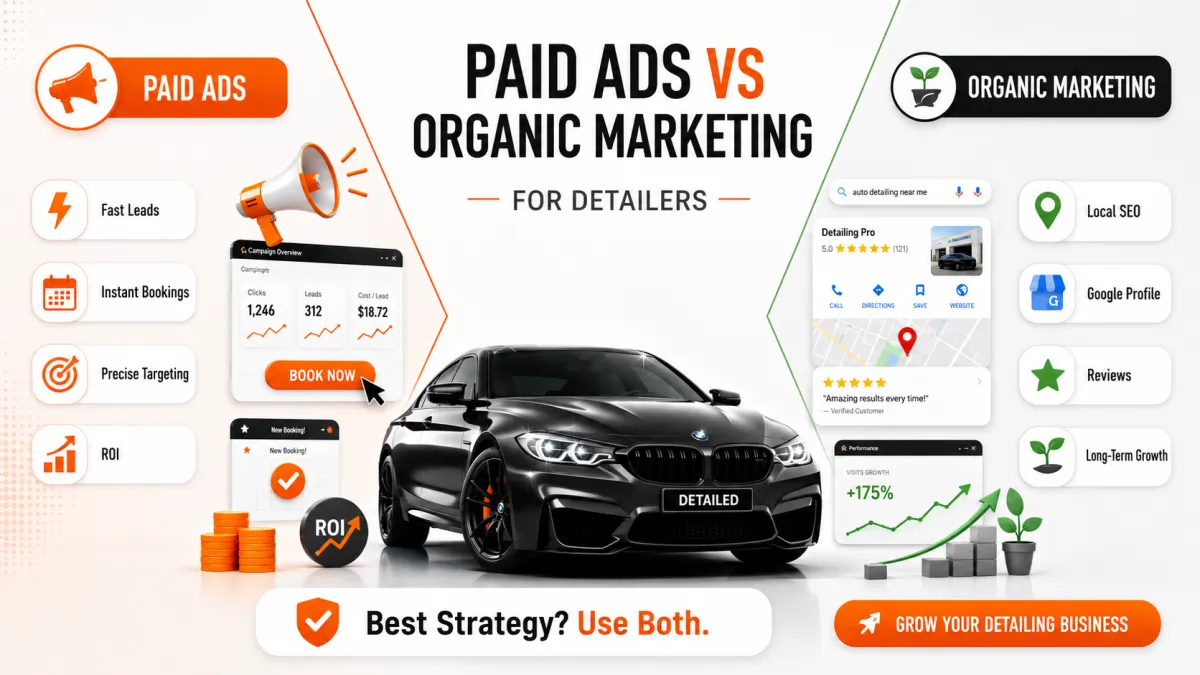
For most auto detailers, paid ads are better when you need booked jobs quickly, while organic marketing is better when you want lower-cost leads and long-term market trust. The right choice depends on your cash flow, service margins, website, reviews, local competition, and how soon you need appointments.
If your shop or mobile detailing business needs calls this month, start with paid ads through Google Ads or Facebook Ads. If you already have steady work and want to reduce dependency on ad spend, invest in local SEO, content, reviews, and website conversion.
The strongest detailers usually do both: paid ads for predictable lead flow and organic marketing for compounding demand.
Key Takeways
Paid ads are usually the better first move when an auto detailer needs leads quickly, especially for ceramic coatings, paint correction, tint, PPF, or higher-ticket detailing packages.
Organic marketing is usually the better long-term investment because local SEO, reviews, website content, and Google Business Profile growth can keep producing leads after the initial work is done.
The biggest mistake is choosing a channel before fixing conversion basics like call tracking, offer clarity, reviews, landing pages, follow-up, and CRM automation.
The best next step is to match the channel to your capacity, margins, market, and timeline, not copy what another detailer is doing.
Paid Ads vs Organic Marketing for Auto Detailers: The Main Decision
You Need Speed, Testing, or Immediate Lead Flow
Paid ads help auto detailers buy attention now and send high-intent traffic to a page built to convert.
- Best when you need booked jobs quickly.
- Useful for Google Ads, Facebook Ads, promotions, and high-ticket service pushes.
- Works well for ceramic coating, tint, PPF, paint correction, and full details.
You Want Durability, Trust, and Long-Term Visibility
Organic marketing helps detailers build demand over time through local SEO, Google Business Profile growth, reviews, content, and reputation.
- Best when you want lower dependency on ad spend.
- Useful for service pages, city pages, reviews, photos, videos, and authority content.
- Works well when the business already has proof and wants stronger local visibility.
Quick Comparison: Paid Ads vs Organic Marketing for Detailers
| Factor | Paid Ads | Organic Marketing | Best Choice |
|---|---|---|---|
| Speed | Can generate leads quickly once tracking, targeting, and landing pages are set up. | Usually takes longer to build traction. | Paid ads for immediate leads. |
| Cost Structure | Requires ongoing media spend plus campaign management. | Requires SEO, content, website, and review work over time. | Depends on budget and timeline. |
| Lead Intent | High on Google Ads; broader on Facebook Ads. | Often high when ranking for service-based searches. | Google Ads or SEO for intent. |
| Control | More control over budget, targeting, offers, and timing. | Less control over timing, rankings, and algorithm changes. | Paid ads for control. |
| Compounding Value | Lead flow usually stops when ad spend stops. | Can compound through rankings, reviews, content, and local trust. | Organic marketing for long-term value. |
| Best Services | Ceramic coating, tint, PPF, paint correction, full details, and promotions. | Core services, city pages, educational content, reviews, and authority assets. | Both when possible. |
| Tracking Needs | Call tracking, form tracking, CRM, and conversion tracking. | Rank tracking, GBP insights, call tracking, CRM, and booked-job reporting. | Both need tracking. |
| Best Overall Use | Best for speed, testing, seasonal campaigns, and immediate lead flow. | Best for long-term growth, reputation, and lower dependency on ad spend. | Usually both, in the right order. |
Option A Explained: Paid Ads for Auto Detailers
Paid ads let detailers get in front of prospects without waiting months for rankings. Google Ads is usually stronger for high-intent searches, while Facebook Ads is usually stronger for demand generation, retargeting, local awareness, and visual before-and-after offers.
High-Intent Search Demand
- Google Ads can target searches like “ceramic coating near me” or “car detailing near me.”
- These prospects are often already comparing providers and ready to call.
Visual Local Awareness
- Facebook Ads can support before-and-after creative, local offers, and retargeting.
- This is useful when the service needs visual proof before someone books.
Best for Profitable Services
- Paid ads work best when acquisition cost can be supported by service margins.
- Ceramic coatings, paint correction, tint, PPF, and premium interiors usually offer more room.
Offer Testing
- Ads help test whether the market responds to coatings, tint specials, fleet detailing, or maintenance packages.
- Testing is faster than waiting for SEO data alone.
Conversion System Required
- Ads should connect to clear landing pages, call tracking, CRM automation, and follow-up.
- The ad gets attention, but the system turns clicks into booked jobs.
Useful Related Guide
- Detailers comparing ad channels can review Facebook Ads vs Google Ads for auto detailers.
- This helps separate search intent from visual demand generation.
Option B Explained: Organic Marketing for Auto Detailers
Organic marketing helps people find and trust your detailing business without clicking a paid ad. For detailers, the strongest organic assets are usually local SEO, Google Business Profile optimization, service pages, city pages, reviews, photos, FAQs, and proof-driven website content.
Local SEO Visibility
- Organic marketing helps detailers appear for searches like “auto detailing near me.”
- It also supports city and service-area visibility over time.
Google Business Profile Growth
- Profile updates, reviews, photos, and accurate service information help build local trust.
- This matters when customers compare multiple detailing shops before contacting one.
Service Pages That Explain Value
- Pages for ceramic coating, paint correction, tint, PPF, interiors, and mobile detailing create clearer search relevance.
- They also help customers understand process, pricing context, and booking steps.
Reviews and Social Proof
- Organic marketing works best when the business has real proof, consistent reviews, and strong before-and-after work.
- That proof helps both Google and customers understand why the detailer is credible.
Compounding Search Assets
- Unlike paid ads, organic assets can continue supporting lead flow after the original work is published.
- Consistent SEO, content, reviews, and website improvements can build long-term demand.
Useful Planning Resources
- For broader planning, review when to invest in local SEO.
- Detailers can also compare local SEO cost for auto detailers.
When Paid Ads Are Better for Detailers
Paid Ads Are Worth It When
- You need speed: Your calendar has open slots and you need calls or form submissions sooner.
- You know your profitable services: You can promote ceramic coating, tint, PPF, paint correction, full details, or fleet work.
- You answer quickly: Calls, texts, and form leads are handled before the prospect shops around.
- You have strong proof: Photos, reviews, clear packages, and a professional page support the ad traffic.
- You can test: Your budget allows testing offers, audiences, keywords, and landing page messaging.
Paid Ads May Not Be Right Yet When
- No tracking is installed: You cannot tell which calls, forms, or booked jobs came from campaigns.
- The offer is unclear: Prospects do not understand the service, price context, or reason to book.
- The landing page is weak: Traffic is sent to a vague homepage instead of a focused service page.
- Follow-up is slow: Missed calls and unreturned messages cause paid leads to leak.
- There is no budget buffer: Ads need testing before they become predictable.
When Organic Marketing Is Better for Detailers
Organic Marketing Is Worth It When
- You want durable growth: You want rankings, reviews, and content to keep supporting visibility over time.
- You have existing proof: Reviews, photos, completed jobs, and customer trust can be packaged into stronger search assets.
- You sell trust-based services: Ceramic coatings, paint correction, PPF, and premium details require more education and proof.
- Your website is thin: Service pages, city pages, FAQs, and galleries can better explain what you offer.
- You want less ad dependency: Organic assets can reduce reliance on always paying for each click.
Organic May Not Be Right Yet When
- You need jobs immediately: SEO and content rarely solve urgent cash flow problems overnight.
- You have no proof: Few reviews, weak photos, or unclear services make organic visibility harder to convert.
- You cannot stay consistent: Organic marketing needs ongoing website, review, profile, and content work.
- Your offer is unclear: Search visibility will not fix confusing packages or poor positioning.
- Your market is competitive: Strong competitors may require deeper local SEO, content, and reputation work.
When to Use Both Paid Ads and Organic Marketing
The best detailers often use paid ads and organic marketing together. Paid ads create fast visibility, while organic marketing builds trust before and after the click.
High-Ticket Services
- Use both when selling services like ceramic coating, paint correction, tint, PPF, or premium details.
- Ads create visibility while organic proof helps prospects feel confident.
Monthly Marketing Budget
- A combined plan works best when there is enough budget for paid traffic and organic assets.
- This prevents the business from choosing only short-term or only long-term growth.
Short-Term and Long-Term Growth
- Paid ads support immediate opportunities.
- Organic marketing supports city rankings, service pages, reviews, and long-term trust.
Capacity to Handle More Leads
- Use both when your shop or mobile team can handle more calls, estimates, and form submissions.
- Marketing should match real operational capacity.
Follow-Up Automation
- CRM automation can help with missed-call follow-up, estimate reminders, and review requests.
- This keeps paid and organic leads from slipping away.
Retargeting Support
- Paid ads can retarget people who visited service pages but did not book.
- Organic assets make those follow-up ads feel more credible.
Common Mistakes Detailers Make With Paid Ads and Organic Marketing
Treating Ads Like a Magic Switch
- Ads can bring attention, but they cannot fix a weak offer or poor phone handling.
- Reviews, landing pages, and follow-up still matter after the click.
Expecting SEO to Work Without Proof
- A thin website with generic content and few reviews usually struggles.
- Detailers need service proof, photos, reviews, and real local trust signals.
Sending Every Visitor to the Homepage
- Dedicated pages usually convert better than a generic homepage.
- Build focused pages for ceramic coating, paint correction, mobile detailing, tint, PPF, interiors, and service areas.
Not Tracking Calls and Forms
- Many detailers judge marketing by feelings instead of data.
- Call tracking, form tracking, CRM stages, and booked-job reporting show what is actually producing revenue.
Copying Another Detailer’s Strategy
- A mobile detailer selling lower-ticket details needs a different plan than a shop selling premium ceramic coatings.
- Strategy should match margins, services, market, and capacity.
Stopping Too Early
- Paid ads need testing, SEO needs consistency, and reviews need a process.
- Marketing performs better when treated like an operating system, not a one-time campaign.
How Virsa Labs Approaches This Decision
Virsa Labs does not treat paid ads vs organic marketing as a generic debate. For auto detailers, the right decision depends on service mix, margins, market size, local competition, reviews, close rate, website quality, and available capacity.
Service Mix
- Virsa Labs looks at which services are most profitable and easiest to sell.
- High-ticket services may support paid acquisition better than low-ticket maintenance work.
Margins and Capacity
- The recommendation changes based on margins, open calendar space, and how many leads the team can handle.
- A busy shop and a newer mobile detailer may need different starting points.
Market and Competition
- Local search competition, ad costs, and nearby competitors affect the channel order.
- The goal is to choose the path that fits the market, not copy another detailer blindly.
Reviews and Reputation
- Strong reviews and real proof make both paid ads and organic marketing easier to convert.
- Weak proof may need reputation and review systems before heavy scaling.
Website and Landing Pages
- Virsa Labs checks whether the site can explain services clearly and turn visitors into leads.
- When needed, the plan may include website development or landing page improvements.
Tracking and Follow-Up
- Call tracking, form tracking, CRM automation, and booked-job reporting help identify what is actually working.
- The goal is not just more clicks; it is more qualified booked opportunities.
Founder-Led Strategy
- Virsa Labs Marketing is founder-led by Harjot Dehal, M.S. & B.S. Computer Science.
- The company works across SEO, paid ads, websites, CRM automation, review systems, call tracking, and lead generation.
Proof Points
- Virsa Labs has 60+ 5-star Google reviews, Lehigh Valley local presence, and national client work across the U.S.
- Readers can review testimonials, case studies, or learn more about Harjot Dehal.
CTA: Need Help Choosing the Right Marketing Channel?
If you are an auto detailer trying to decide between paid ads, organic marketing, or both, the best next step is not guessing. It is looking at your services, margins, city, competition, website, reviews, and follow-up process.
Virsa Labs can help you decide whether to start with paid ads, local SEO, landing pages, CRM automation, or a combined growth plan.
If you want a practical recommendation for your detailing business, contact Virsa Labs through the contact page.
FAQ
Are paid ads or organic marketing better for auto detailers?
Paid ads are better for speed, while organic marketing is better for long-term visibility and trust. Most detailers should use paid ads when they need leads quickly and organic marketing when they want compounding local growth.
Should a new detailing business start with paid ads or SEO?
A new detailing business often needs paid ads first if it has open capacity and needs appointments quickly. SEO should still be started early, but it usually takes longer to become a reliable lead source.
Is Google Ads or Facebook Ads better for detailers?
Google Ads is usually better for high-intent searches like ceramic coating, paint correction, or car detailing near me. Facebook Ads can work well for visual offers, retargeting, seasonal promotions, and before-and-after creative.
Does organic marketing include social media?
Yes, but social media is only one part of organic marketing. For detailers, organic marketing usually includes local SEO, Google Business Profile, reviews, website content, service pages, city pages, photos, videos, and reputation building.
How much should detailers spend on paid ads?
It depends on the market, service prices, competition, and close rate. A shop selling higher-ticket services can usually justify more ad spend than a detailer selling low-ticket maintenance washes. The budget should be tied to margins and lead quality, not vanity metrics.
How long does organic marketing take for detailers?
Organic marketing usually takes time because search visibility, reviews, content, and authority build gradually. Some improvements can happen quickly, but meaningful SEO growth often requires consistent work over months.
Can paid ads help SEO?
Paid ads do not directly make a website rank higher in organic search. However, ads can increase brand searches, bring more visitors, support retargeting, and reveal which services and messages convert best.
What should detailers fix before running ads?
Detailers should fix offer clarity, call tracking, landing pages, reviews, photos, phone handling, and follow-up before spending heavily. Without those basics, ad traffic can be wasted.
What should detailers fix before investing in SEO?
Detailers should make sure their website clearly explains services, locations, pricing context, proof, reviews, and booking steps. Google Business Profile accuracy and review generation are also important.
When should a detailer use both paid ads and organic marketing?
A detailer should use both when the business has enough budget, profitable services, good proof, and capacity to handle more leads. Paid ads can generate short-term opportunities while organic marketing builds long-term demand.
Schedule an appointment today!