Virsa Labs Marketing » Facebook ads vs google ads for auto detailers
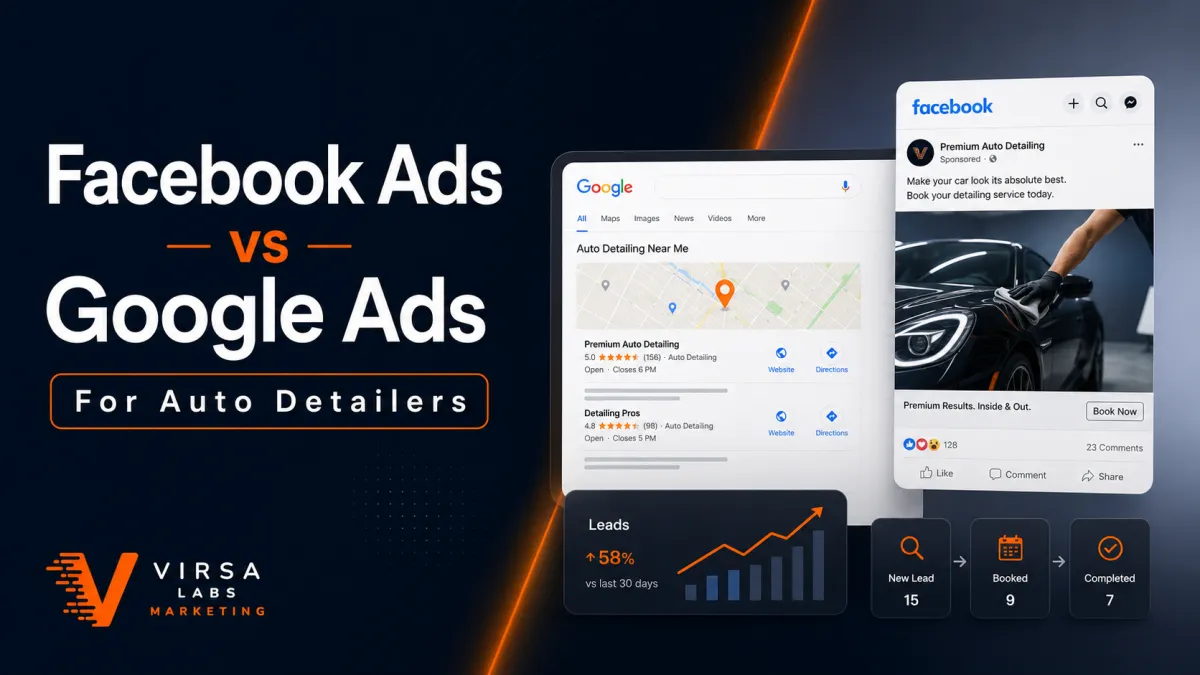
Facebook Ads vs Google Ads for Auto Detailers

Local SEO Services
SEO in Lehigh Valley
Local SEO in Lehigh Valley
Website Development
CRM Automation
Case Studies
Client Testimonials
Book a Strategy Review
Facebook Ads vs Google Ads for Auto Detailers: Which Gets Better Leads?
For most auto detailers, Google Ads is the better first paid ads channel because it captures people already searching for ceramic coating, mobile detailing, paint correction, interior detailing, or “auto detailer near me.” Facebook Ads can work, but it usually performs best when you have a strong offer, good visuals, fast follow-up, and a retargeting system. The practical answer is this: use Google Ads for high-intent booking demand, use Facebook Ads for offer-driven demand creation, and use both once your tracking and sales process can handle lead volume.
Key Takeways
Google Ads usually wins for ready-to-book auto detailing leads because the customer is actively searching for a service now.
Facebook Ads can be cheaper per lead, but lead quality is more inconsistent unless your offer, creative, targeting, and follow-up are dialed in.
The biggest mistake is judging platforms only by cost per lead instead of booked jobs, show rate, average ticket, and return on ad spend.
Most detailers should start with Google Ads, add retargeting, then test Facebook Ads once the business can respond quickly and track every lead.
Which Is Better for Auto Detailers: Facebook Ads or Google Ads?
For an auto detailer with a limited budget, Google Ads is usually the stronger starting point because it captures people already searching for services like ceramic coating, mobile detailing, paint correction, interior detailing, or “auto detailer near me.” Facebook Ads can still work, but it usually needs stronger visuals, a clearer offer, faster follow-up, and a retargeting system.
Facebook Ads
Facebook Ads creates demand by putting your offer in front of people while they browse Facebook, Instagram, Messenger, and other Meta placements.
- Best for visual offers, before-and-after content, seasonal packages, and retargeting.
- Works better when the detailer has strong photos, videos, hooks, and a fast follow-up process.
- Can generate leads quickly, but lead quality is more inconsistent when the audience is cold.
Google Ads
Google Ads captures existing demand by showing your detailing business when people are already searching for local services.
- Best for high-intent searches like ceramic coating, mobile detailing, paint correction, and interior detailing.
- Usually produces warmer leads when keywords, locations, and landing pages are controlled properly.
- Pairs well with call tracking, service-specific landing pages, and local SEO over time.
Quick Comparison: Facebook Ads vs Google Ads for Auto Detailers
| Factor | Facebook Ads | Google Ads | Best Choice |
|---|---|---|---|
| Customer intent | Lower intent because the user is browsing, not searching. | Higher intent because the user is actively searching for detailing help. | Google Ads |
| Best use case | Offers, before-and-after visuals, retargeting, and awareness. | Ceramic coating, detailing, mobile detailing, and paint correction leads. | Google Ads |
| Lead cost | Often lower cost per form lead. | Often higher cost per click or lead. | Depends on booking rate |
| Lead quality | Can vary widely without strong offers and fast follow-up. | Usually more qualified when keywords and locations are controlled. | Google Ads |
| Retargeting value | Very strong for people who visited the site or engaged with content. | Strong when combined with display, video, and remarketing. | Facebook Ads |
| Long-term strategy | Great support channel for education, proof, and offer testing. | Great primary acquisition channel for high-intent searches. | Use both once tracking works |
Option A Explained: Facebook Ads for Auto Detailers
Demand Creation
- Facebook Ads reaches people before they actively search.
- It works best when the ad gives local car owners a reason to act now.
Visual Creative
- Before-and-after interiors, pet hair removal, and paint correction content can stop the scroll.
- Ceramic coating water-beading shots and dirty-to-clean reels are strong creative assets.
Offer Clarity
- Defined offers usually work better than a generic “book now” message.
- Examples include seasonal detail packages, interior resets, or ceramic coating consultations.
Lead Quality Risk
- Facebook form leads may be curious, price shopping, or not fully ready to book.
- The campaign must be judged by booked jobs, not just cheap form fills.
Fast Follow-Up
- Facebook leads can go cold quickly if nobody responds fast.
- CRM follow-up, missed-call replies, and quote reminders help protect ad spend.
Retargeting Fit
- Facebook is useful when you already have website traffic, video views, or past leads.
- Retargeting can bring back people who looked but did not book.
Option B Explained: Google Ads for Auto Detailers
Search Intent
- Google Ads reaches people while they are actively searching for detailing services.
- Searchers are often closer to calling, comparing, or booking.
Buyer Keywords
- Strong terms include “auto detailing near me,” “mobile detailing near me,” and “ceramic coating installer.”
- Paint correction, interior detailing, and city-based searches can also show buying intent.
Better Timing
- The customer is already looking for a solution when the ad appears.
- This is why Google Ads often produces fewer but warmer leads than Facebook.
Waste Control
- Negative keywords are needed to avoid DIY searches, job seekers, and irrelevant car wash traffic.
- Location targeting helps prevent clicks from people outside the service area.
Landing Page Fit
- Search traffic should go to a relevant service page, not a generic homepage.
- Ceramic coating, mobile detailing, and interior detail traffic need matching page content.
Full Lead System
- Website development, call tracking, and lead generation systems support better results.
- The campaign performs better when reviews, calls, forms, and follow-up are connected.
When Facebook Ads Is Better for Auto Detailers
Facebook Ads Is Better When
- You need demand creation: The customer may want the service but is not actively searching yet.
- You have strong visuals: Before-and-after photos, water-beading clips, and transformation reels can create interest.
- You have a clear offer: Seasonal packages, gift cards, consultations, and maintenance plans are easier to promote.
- You want retargeting: Facebook can bring back people who visited your website or engaged with your content.
- You can follow up fast: Fast replies help prevent cold Facebook leads from going silent.
Facebook Ads May Not Be Right Yet When
- You only want ready-to-book calls: Cold Facebook traffic usually has lower intent than Google Search traffic.
- Your offer is generic: “Contact us today” is usually weak for interruption-based advertising.
- Your creative is thin: Auto detailing is visual, so weak photos and videos make the campaign harder to convert.
- Your follow-up is slow: Waiting hours to reply can reduce booking quality.
- Your tracking is weak: Cheap leads can look good while booked jobs stay low.
When Google Ads Is Better for Auto Detailers
Ready-to-Book Demand
- Google Ads is stronger when people are already comparing local detailers.
- Searches like “paint correction near me” usually show clear buying intent.
Higher-Ticket Services
- Google Ads can work well for ceramic coating, paint correction, odor removal, and interior restoration.
- These services often need proof, reviews, and a clear next step.
Service Area Control
- Local detailers should avoid clicks from people too far away to become customers.
- Radius targeting, city-level keywords, and local landing pages help reduce waste.
Local SEO Pairing
- Paid search can bring leads now while local SEO builds long-term visibility.
- This is useful for auto detailers in competitive local markets.
Strong Reviews
- Searchers often compare trust signals before calling or submitting a quote request.
- Reviews, photos, and service pages help turn clicks into booked opportunities.
Fast Call Handling
- Google Ads works best when calls and forms are answered quickly.
- Missed calls, slow replies, and weak landing pages can make paid search more expensive.
When Auto Detailers Should Use Both
Google Captures Demand
- Use Google Search Ads for bottom-of-funnel services like ceramic coating and paint correction.
- The goal is to reach people who are already looking for a local detailer.
Landing Pages Convert
- Send ad traffic to service-specific pages that explain the offer and answer buyer questions.
- Pages should include proof, reviews, pricing context, and a clear call or quote step.
Facebook Retargets
- Use Facebook Ads to retarget website visitors, video viewers, form openers, and social engagers.
- Retargeting audiences already know the brand, so the ads are not completely cold.
Proof Builds Trust
- Facebook retargeting can show before-and-after work, reviews, and reasons to come back.
- This supports people who visited the site but were not ready to book.
Budget Stays Focused
- Google should usually get first priority when search demand and booking intent are clear.
- Facebook can start with a smaller testing or retargeting budget.
Revenue Decides Split
- The budget split should change based on booked revenue, not vanity metrics.
- Tracking should show which platform creates qualified leads, booked jobs, and profitable services.
Budget and Tracking: What Actually Decides the Winner
A small auto detailing business should not judge ads by impressions, clicks, or cheap leads alone. The useful numbers are cost per qualified lead, cost per booked job, show rate, close rate, average ticket, and repeat purchase potential.
| Metric | What It Shows | Why It Matters | What to Track |
|---|---|---|---|
| Cost per qualified lead | How much it costs to generate a lead that fits the service. | Cheap leads can be misleading if they are not serious buyers. | Lead source, service requested, location, and lead quality. |
| Cost per booked job | How much ad spend is needed to create an actual appointment. | This is more useful than cost per lead for comparing Facebook and Google. | Booked appointments, no-shows, cancellations, and source platform. |
| Show rate and close rate | How many leads become real customers. | Facebook may need faster follow-up, while Google may produce warmer inquiries. | Calls answered, forms contacted, quotes sent, and jobs closed. |
| Average ticket | The revenue value of each service type. | A ceramic coating lead, maintenance wash lead, and interior cleaning lead are not equal. | Revenue by service, platform, campaign, and landing page. |
| Follow-up speed | How quickly the business contacts new leads. | Slow replies can make Facebook leads decay quickly and reduce paid search performance. | Response time, missed calls, text replies, and quote reminders. |
| CRM and call tracking | Whether the business can see which ads became revenue. | Without tracking, budget decisions become guesswork. | CRM automation, call tracking, form tracking, and booked-job reporting. |
Common Mistakes Auto Detailers Make With Facebook and Google Ads
Sending Traffic to the Homepage
- A homepage usually has too many distractions for paid traffic.
- Ceramic coating, mobile detailing, and interior detailing traffic should go to matching service pages.
Using Weak Offers
- “Contact us today” is often too vague for cold Facebook traffic.
- A package, consultation, seasonal service, or clear next step gives people a reason to act.
Running Broad Keywords
- Broad Google keywords can spend quickly without conversion tracking and negative keywords.
- Search terms should be reviewed often, especially early in the campaign.
Treating Every Lead the Same
- A ceramic coating lead is not equal to a bargain interior cleaning lead.
- Campaign reporting should separate service types so budget moves toward profitable work.
Ignoring Reviews and Proof
- Auto detailing is visual and trust-based.
- People want to see real vehicles, real results, and signs that their car will be handled carefully.
Not Reviewing Proof Before Scaling
- Before increasing spend, review testimonials, case studies, lead quality, and booked revenue.
- Ad accounts can look healthy while the business still lacks profitable appointments.
How Virsa Labs Approaches This Decision
Virsa Labs does not treat Facebook Ads vs Google Ads as a generic platform debate. The right answer depends on the auto detailer’s service mix, market, pricing, capacity, reputation, and follow-up process.
For a detailer trying to book higher-intent services quickly, we usually look at Google Ads first. We want to know which services are most profitable, which cities matter, what the average ticket is, how calls are handled, and whether the website can convert search traffic.
For a detailer with strong visuals, a good offer, and enough budget to test creative, Facebook Ads can become a strong growth channel. It may also support Google campaigns by retargeting website visitors who did not convert the first time.
The Virsa Labs approach is to connect ads with the full customer journey: search intent, landing pages, tracking, CRM automation, reviews, and follow-up. That matters because ad performance is not only created inside the ad account.
Virsa Labs Marketing is founder-led by Harjot Dehal, M.S. & B.S. Computer Science, Local SEO & Paid Ads Specialist. The company works with auto detailers, dentists, medical practices, contractors, home service businesses, and local service businesses across the Lehigh Valley and nationally across the U.S. Proof points include 60+ 5-star Google reviews, case studies, testimonials, and hands-on experience across SEO, paid ads, websites, CRM automation, review systems, call tracking, and lead generation.
For detailers comparing providers, it may also help to review best marketing agencies for auto detailers, local SEO cost for auto detailers, and SEO vs Google Ads for local businesses.
Ready to Decide Which Ad Channel Fits Your Detailing Business?
If you are an auto detailer trying to choose between Facebook Ads and Google Ads, start with the business outcome: more ceramic coating jobs, more mobile detailing bookings, more interior details, more recurring customers, or better lead quality.
Virsa Labs can help you decide which channel should get budget first, what needs to be fixed before scaling, and how to track whether the ads are actually producing booked revenue.
Schedule a strategy conversation through contact us and bring your current ad account, website, service list, and average job value. The goal is not to spend more money on ads. The goal is to build a lead system that makes sense for your detailing business.
FAQ
Is Facebook Ads or Google Ads better for auto detailers?
Google Ads is usually better for auto detailers who want high-intent leads because people are actively searching for detailing services. Facebook Ads is better for offers, retargeting, education, and visual demand creation.
Should a new auto detailing business start with Facebook Ads or Google Ads?
Most new detailers should start with Google Ads if there is search demand in their area and they have a decent website or landing page. Facebook Ads can work early, but it usually needs stronger creative, offers, and faster follow-up.
Are Facebook leads lower quality than Google leads?
Often, yes. Facebook leads can be cheaper but less ready to book. Google leads usually have stronger intent because the customer searched for the service. The only fair comparison is cost per booked job, not cost per lead.
What budget should an auto detailer start with for ads?
A practical starter budget depends on the market and service mix, but many local detailers need enough budget to generate meaningful data over 30–60 days. A very small budget can work for retargeting, but competitive Google Search campaigns usually need enough spend to test keywords, locations, and landing pages.
Do Google Ads work for ceramic coating leads?
Yes, Google Ads can work well for ceramic coating because searchers often have higher buying intent. The campaign needs strong keyword targeting, service-specific landing pages, proof, reviews, and call tracking.
Do Facebook Ads work for eramic coating?
Facebook Ads can work for ceramic coating when the ads educate the customer. Videos, before-and-after photos, water-beading clips, and simple explanations can help create demand before someone searches Google.
Should auto detailers run lead forms or send traffic to a website?
For Facebook, lead forms can reduce friction but may lower lead quality. For Google, sending traffic to a strong service landing page is often better because the visitor is already searching and may need proof before calling.
What is the biggest reason auto detailing ads fail?
The biggest reason is weak tracking and follow-up. Many detailers do not know which leads booked, which services produced revenue, or how quickly leads were contacted. Without that data, budget decisions become guesswork.
Can local SEO replace paid ads for auto detailers?
Local SEO can reduce dependency on paid ads over time, but it usually does not replace paid ads immediately. A smart strategy often uses paid ads for near-term demand while local SEO builds long-term visibility.
Does Virsa Labs manage both Facebook Ads and Google Ads?
Yes. Virsa Labs Marketing works on SEO, Google Ads, Facebook Ads, websites, CRM automation, review systems, call tracking, and lead generation for auto detailers and other local service businesses.
Schedule an appointment today!