Virsa Labs Marketing »Dental SEO vs Traditional Dental Marketing
Dental SEO vs Traditional Dental Marketing

Local SEO Services
SEO in Lehigh Valley
Local SEO in Lehigh Valley
Website Development
CRM Automation
Case Studies
Client Testimonials
Book a Strategy Review
Dental SEO vs Traditional Dental Marketing
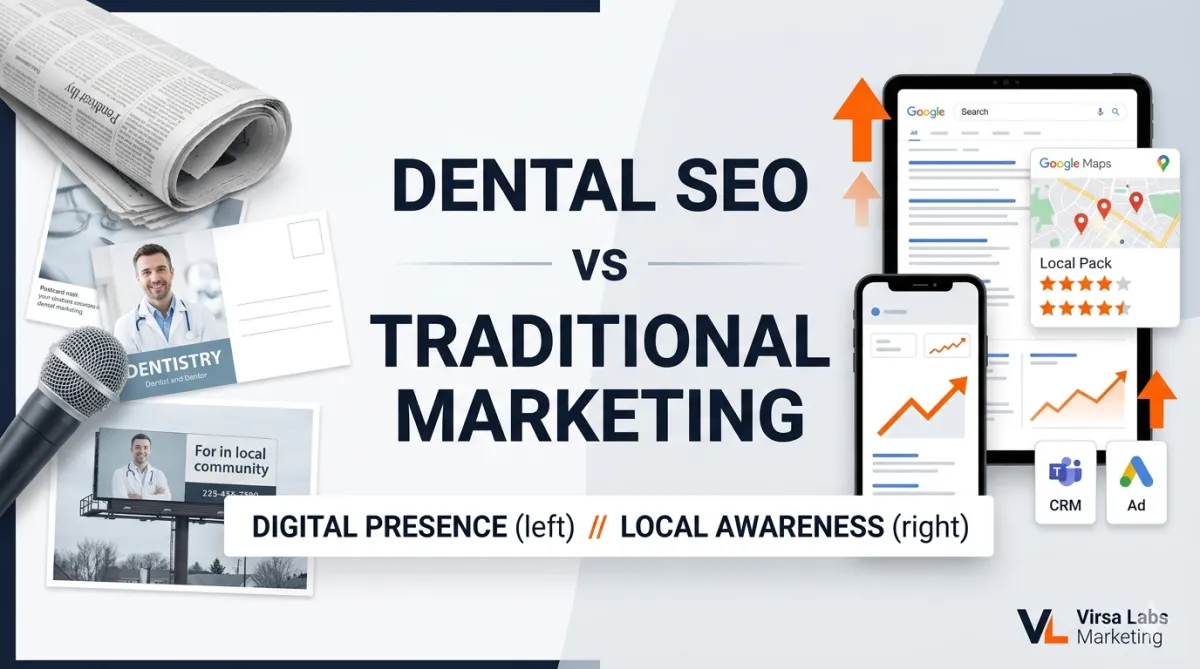
If you’re a dentist looking to grow your practice, choosing between Dental SEO and traditional dental marketing can directly impact your patient flow and ROI. In short: Dental SEO delivers measurable online visibility and targeted patient leads over time, whereas traditional methods like print ads, radio, and direct mail work best for immediate local brand awareness but often lack precise tracking and ROI.
Key Takeways
Dental SEO builds long-term, measurable patient growth, while traditional marketing provides short-term visibility.
Local SEO and Google Business Profile optimization often outperform generic ads in capturing high-intent patients nearby.
Combining both approaches can maximize reach: SEO sustains online presence, while select traditional campaigns boost immediate awareness.
Mistake to avoid: relying solely on traditional marketing in a digitally-driven patient acquisition landscape.
Dental SEO vs. Traditional Marketing: Quick Comparison
| Factor | Dental SEO | Traditional Dental Marketing | Best Choice |
|---|---|---|---|
| Target Audience | Patients searching online for dental services locally. | General public through radio, print, and flyers. | SEO for high-intent patients. |
| Cost Structure | Monthly retainer; scalable and long-term. | Per-campaign basis; less predictable ROI. | SEO for predictable cost. |
| Measurability | Trackable via analytics, calls, and forms. | Hard to measure exact patient conversions. | SEO for data-driven results. |
| Time to Results | 3–6 months to build momentum. | Immediate awareness but short-lived. | SEO for long-term growth. |
| Reach | Local, hyper-targeted digital reach. | Broad, less targeted demographic reach. | SEO for local dominance. |
| ROI | Often higher long-term ROI. | Can be expensive with limited tracking. | SEO for cost-efficiency. |
| Brand Visibility | Online search dominance, GMB, reviews. | Billboards, newspapers, radio. | Both for combined impact. |
What is Dental SEO?
GBP Optimization
- Claim and verify your Google Business Profile.
- Regularly update business info, photos, and offers.
On-Page SEO
- Optimize website content for dental-specific keywords.
- Improve page load speeds for better user experience.
Local Citations
- Ensure NAP (Name, Address, Phone) consistency.
- List your practice in local directories and maps.
Review Management
- Systematically request reviews from satisfied patients.
- Respond professionally to all feedback to build trust.
Authority Building
- Acquire backlinks from relevant local health sources.
- Publish content that positions your practice as local experts.
Tracking & Analytics
- Monitor performance via Google Analytics and Search Console.
- Use call tracking to attribute leads directly to SEO efforts.
What is Traditional Dental Marketing?
Print Advertising
- Ads in local newspapers, community magazines, or coupon mailers.
- Useful for reaching older demographics who rely on physical media.
Direct Mail
- Postcards and flyers sent to specific neighborhoods or zip codes.
- Good for announcing new practice openings or seasonal promotions.
Broadcast Media
- Radio spots or local cable television advertisements.
- Effective for building broad name recognition across a city.
Out-of-Home (OOH)
- Billboards, bus stop signage, or transit advertisements.
- High visibility, but limited ability to target specific patient needs.
Community Events
- Sponsorships of local sports teams, festivals, or charity events.
- Strengthens your practice's image as a pillar of the community.
Referral Programs
- Printed referral cards or physical networking with local businesses.
- Leverages word-of-mouth in a tangible, trackable format.
When Local SEO is Better
Worth It When
- High-Intent Capture: You want to reach patients actively searching for "dentist near me."
- Scalable ROI: You need a marketing channel that improves in efficiency as your domain authority grows.
- Data-Driven Decisions: You value tracking every call, form fill, and conversion back to a specific source.
- Market Authority: You are aiming to dominate Google Maps and local search results over the long term.
- Sustainable Growth: You prefer building an asset that generates leads even when you aren't actively running a paid campaign.
May Not Be Right Yet When
- Immediate Crisis: You need patients in your chair by tomorrow morning to cover urgent overhead.
- New Office Launch: You have zero brand awareness and need to blanket the local community instantly.
- Temporary Offers: You are running a seasonal promotion that expires in less than 30 days.
- No Digital Budget: You are not prepared to invest in content, technical site health, or ongoing management.
- Preference for Manual Outreach: You are heavily committed to physical community networking and have no interest in online presence.
When Traditional Marketing is Better
Worth It When
- Grand Openings: You need to generate instant, localized buzz for a new practice launch.
- Community Branding: You want to solidify your reputation through local event sponsorships and festivals.
- Hyper-Local Reach: You want to saturate a specific neighborhood or zip code with high-visibility direct mail.
- Patient Trust: You are targeting older demographics who respond well to physical touchpoints like print ads.
- Multi-Channel Reinforcement: You want to ensure your brand is seen both online and offline to increase "mental availability."
May Not Be Right Yet When
- Budget Constraints: You have limited funds; traditional ads lack the trackable ROI needed to justify high costs.
- Scaling Online Leads: You are looking for a measurable, predictable flow of new patient appointments from search.
- Lack of Tracking: You have no mechanism (like unique phone numbers) to measure which specific ad drove a patient.
- Long-Term Efficiency: You want an asset that builds value over time rather than a "one-and-done" campaign.
- Targeting Specific Services: You need to target high-intent patients searching for specific procedures like implants or Invisalign.
When Dental SEO is Better
Combining SEO and traditional marketing is not about doing everything at once; it is about creating a "surround sound" effect. By using both, you ensure that potential patients see your brand in their physical community while simultaneously finding you at the top of their digital search results.
The SEO Role
SEO serves as the long-term engine for your practice, capturing high-intent patients who are actively searching for dental solutions.
- Captures patients exactly when they need a dentist.
- Provides measurable ROI through tracking and analytics.
- Builds long-term digital authority and reputation.
The Traditional Role
Traditional marketing acts as the accelerator, providing immediate community recognition and brand trust that complements your digital presence.
- Generates instant awareness during office launches or promotions.
- Strengthens local ties through community involvement.
- Reaches demographics that may not be active in digital search.
Common Mistakes to Avoid
Avoiding strategic pitfalls is just as important as implementing the right tactics. Below are common errors that can prevent your dental practice from reaching its full growth potential.
Digital Neglect
- Relying solely on print ads or physical mailers.
- Failing to establish a robust online search presence.
GBP Inactivity
- Ignoring your Google Business Profile updates.
- Failing to proactively manage patient reviews.
Wasted Ad Spend
- Over-spending on non-targeted traditional media.
- Lacking clear attribution to track actual ROI.
Impatience with SEO
- Expecting overnight rankings for competitive terms.
- Quitting before the 3–6 month momentum window.
Poor Conversion Paths
- Sending traffic to pages without clear calls to action.
- Failing to track form submissions and phone leads.
Ignoring Competitors
- Not identifying local content or authority gaps.
- Failing to adapt to changing local search trends.
How Virsa Labs Approaches This Decision
Worth It When
- Growth-Oriented: You are ready to scale your practice with a predictable, data-backed system.
- Evidence-Based: You prefer working with a team that values KPIs and proven, 5-star results.
- Time-Constrained: You want experts to handle your technical SEO and CRM so you can focus on patient care.
- Local Focus: You need an agency that understands both the national dental landscape and your specific market.
- Systematized Marketing: You want a holistic approach that connects your website, ads, and office systems.
May Not Be Right Yet When
- DIY Preference: You have the time and technical expertise to manage your own SEO and ad campaigns.
- Short-Term Vision: You are looking for a "magic bullet" and are not prepared for a long-term partnership.
- No Budget Allocation: You are not ready to view marketing as a high-ROI business investment.
- Resistance to Change: You are uncomfortable integrating new tools like CRM automation or call tracking.
- Internal Team Capacity: You already have a full-service, in-house marketing department that is meeting all your goals.
CTA: Get Your Free Local Visibility Audit
Ready to grow your dental practice with a measurable online strategy? Schedule a free consultation with Harjot Dehal, our founder and Local SEO & Paid Ads Specialist, to see how we can maximize your patient flow.
FAQ
How long does it take for dental SEO to show results?
Usually 3–6 months, depending on competition and optimization efforts.
Is traditional marketing worth it for small dental practices?
Yes, for immediate local awareness or promoting events, but ROI is harder to track than SEO.
Can I use SEO and traditional marketing together?
Absolutely combining both ensures long-term visibility and short-term patient awareness.
How much does dental SEO cost?
Costs vary; see our detailed guide on dental SEO pricing.
Do online reviews impact dental SEO?
Yes, review quantity, quality, and response significantly affect local search rankings.
Should I run Google Ads instead of SEO?
Paid ads can drive instant traffic, but SEO builds sustainable, long-term leads. See our SEO vs Google Ads comparison.
Is a website redesign necessary for SEO?
Not always, but a well-optimized website improves rankings, user experience, and conversions. Check website redesign guidance.
What’s the first step for a practice new to SEO?
Start with a local SEO audit and GBP optimization to identify opportunities for quick wins.
Do you handle both local SEO and paid ads?
Yes, Virsa Labs specializes in integrated strategies combining SEO, Google Ads, and Facebook Ads.
How do I know if my traditional campaigns are working?
Tracking phone calls, coupon codes, or patient mentions can provide some insight, but measurement is less precise than SEO.
Schedule an appointment today!