Google Business Profile Optimization
Local SEO starts with making the dental practice easier to find and trust on Google Maps through accurate categories, services, photos, office details, and local relevance signals.
Virsa Labs Marketing » Local SEO vs PPC for Dentists: Which One Is Better for Your Practice?

Dental Digital Marketing
SEO in Lehigh Valley
Local SEO in Lehigh Valley
Website Development
CRM Automation
Case Studies
Client Testimonials
Book a Strategy Review
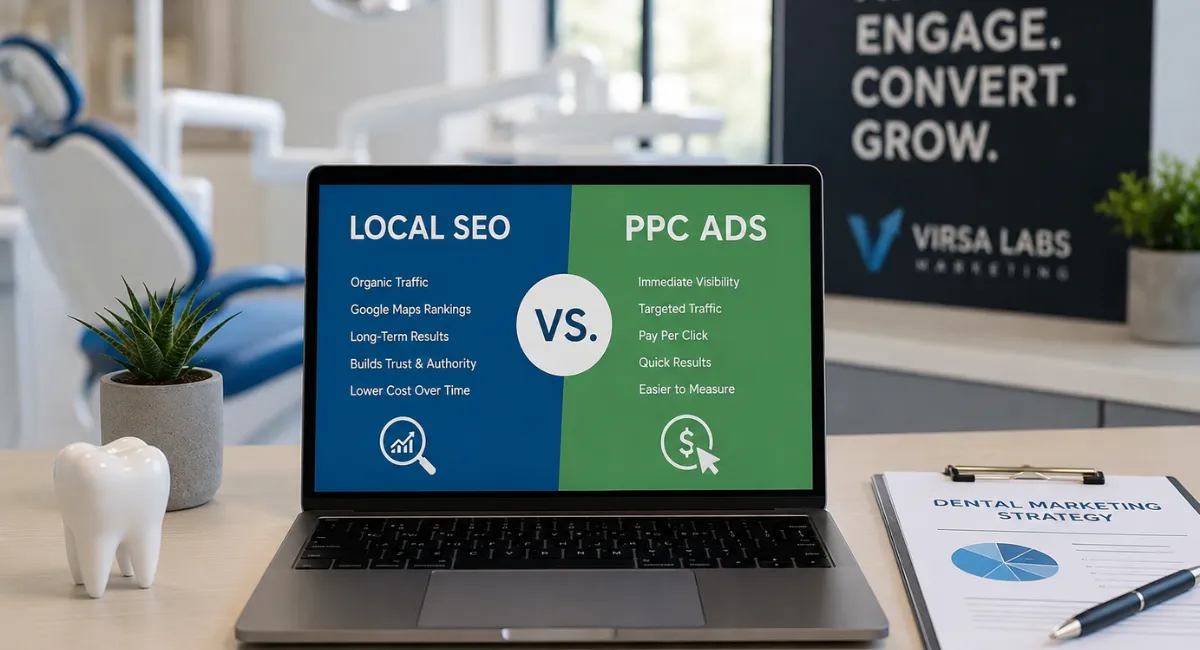
For most dental practices, local SEO is the better long-term investment, while PPC is better when you need patients quickly. If your practice needs immediate calls for implants, emergency dentistry, Invisalign, or new patient exams, PPC can create faster visibility. But if you want lower long-term lead costs, stronger Google Maps visibility, and a more trusted online presence, local SEO should be the foundation.
The best answer is usually not “SEO or PPC.” It is SEO first for long-term authority, PPC strategically for speed and high-value services.
Key Takeways
Local SEO is usually better for dentists who want sustainable patient growth from Google Maps, organic search, reviews, and service-area visibility.
PPC is better when a dental office needs faster patient volume, wants to promote a specific treatment, or is entering a competitive market with little organic visibility.
The common mistake is spending heavily on ads before fixing the website, tracking, call handling, reviews, and follow-up process.
The strongest strategy for most dental practices is to use PPC for immediate demand while building local SEO as the long-term acquisition asset.
| Factor | Local SEO | PPC | Best Choice |
|---|---|---|---|
| Speed | Slower to build and usually takes months of consistent work. | Can create faster visibility once campaigns are live. | PPC when the practice needs patient opportunities quickly. |
| Long-Term Value | Builds lasting visibility through Google Maps, organic rankings, content, reviews, and local authority. | Traffic usually stops when the ad budget stops. | Local SEO for long-term patient acquisition. |
| Best Use Case | General dentistry, family dentistry, preventive care, local searches, and broad service visibility. | Emergency dentistry, implants, Invisalign, cosmetic dentistry, dentures, and new patient offers. | Use based on goal and service priority. |
| Patient Trust | Strong because patients see reviews, website pages, maps presence, and organic credibility. | Can work well, but some users skip sponsored results. | Local SEO for trust-heavy dental decisions. |
| Control | Less control over exact ranking speed and timing. | More control over budget, location, keywords, schedule, and landing page focus. | PPC for campaign control. |
| Tracking Needs | Needs call tracking, form tracking, rankings, GBP insights, and CRM attribution. | Needs conversion tracking, call tracking, keyword analysis, landing pages, and CRM attribution. | Both need proper tracking before judging performance. |
| Risk | Takes time and requires consistent execution. | Can waste money quickly if targeting, tracking, or landing pages are weak. | Depends on execution and practice readiness. |
| Best Overall Strategy | Builds long-term visibility, trust, and market authority. | Adds speed, service focus, and short-term demand capture. | Use both together for serious growth plans. |
For most dentists, the right decision is this:
Use PPC when timing matters.
Use local SEO when ownership matters.
Use both when growth matters.
That means PPC can help generate patient opportunities now, while local SEO builds the practice’s long-term visibility, trust, and lower-cost lead flow over time.
Local SEO starts with making the dental practice easier to find and trust on Google Maps through accurate categories, services, photos, office details, and local relevance signals.
Dental decisions are trust-heavy. Reviews, ratings, photos, staff information, and clear office details help patients compare one practice against nearby competitors before calling.
A single generic services page is usually not enough. Practices often need separate pages for implants, emergency dentistry, cosmetic dentistry, Invisalign, family dentistry, and other core treatments.
Dental practices in competitive markets need content that connects services with local search intent, including city-specific and nearby-area searches where patients are actively comparing options.
SEO performance is tied to website quality. Mobile experience, speed, crawlability, page structure, internal linking, and clear calls to action all affect patient acquisition.
Useful dental content helps answer buyer questions around treatments, cost factors, urgency, insurance, appointment steps, and what patients should expect before contacting the office.
Consistent business information across local directories, dental profiles, and trusted platforms helps support local relevance and reduces confusion for search engines and patients.
The goal is not just ranking. A strong local SEO system tracks calls, forms, appointment requests, and booked patients so the practice can understand what is actually producing value.
A well-built service page, review profile, and optimized Google Business Profile can keep supporting visibility over time, unlike paid traffic that usually stops when the ad budget stops.
PPC allows a dental practice to pay for visibility on searches related to specific services instead of waiting for organic rankings to improve over time.
When the offer, landing page, tracking, and follow-up process are strong, PPC can create patient opportunities faster than SEO for the right dental services.
Emergency dentistry often fits PPC because someone searching for an emergency dentist open today usually needs help now and may be ready to call immediately.
Dental implants, Invisalign, veneers, dentures, cosmetic consultations, and similar services can make sense for PPC when patient value and close rate support the cost.
Strong dental PPC should not send every click to the same place. Campaigns should be organized around clear services, search intent, location, and landing page relevance.
PPC can waste money without clean targeting. Dentists should filter irrelevant searches tied to jobs, free advice, wrong locations, unsupported insurance, or services the office does not provide.
Paid clicks should go to focused landing pages that explain the treatment, trust factors, next steps, and appointment options instead of forcing patients to search through a generic homepage.
PPC performance depends on more than clicks. Call tracking, form tracking, CRM automation, and fast follow-up help reveal which paid leads become real patient opportunities.
PPC gives more control over budget, keywords, schedule, and service focus, but weak execution can make the ad account look like the problem when the real issue is conversion.
At Virsa Labs Marketing, we do not look at local SEO and PPC as separate services. We look at them as parts of the same patient acquisition system. For dentists, the real goal is not just more traffic. The goal is qualified patient opportunities, clear tracking, strong follow-up, and more booked appointments.
That is why we look at the full system before recommending SEO, PPC, or both. This includes the Google Business Profile, website quality, service pages, landing pages, reviews, call tracking, CRM automation, ad campaigns, and follow-up process. If a campaign creates clicks but no appointments, the system still needs work.
Our approach is practical. Build local SEO as the long-term foundation for visibility, trust, and Google Maps presence. Use PPC when speed matters or when the practice wants to promote high-value services like implants, emergency dentistry, Invisalign, or cosmetic dentistry. The best channel mix depends on the practice’s market, competition, website, reviews, and growth goals.
If you are unsure whether your dental practice should invest in local SEO, PPC, or both, Virsa Labs Marketing can help you make the decision based on your market, competition, website, reviews, service mix, and growth goals.
We can review where your practice currently stands, identify the biggest gaps, and recommend the channel mix that makes the most business sense.
Start with a practical review of your current marketing system through our dental marketing services, see our case studies, or contact Virsa Labs Marketing to discuss your practice.
Local SEO is usually better for long-term growth, while PPC is better for faster visibility. If your dental practice needs immediate patient opportunities, PPC can help. If you want stronger Google Maps rankings, organic visibility, and long-term market presence, local SEO is usually the better foundation.
Local SEO usually takes time because Google needs to evaluate your website, Google Business Profile, reviews, local relevance, content, and authority. Some improvements can happen earlier, but competitive dental markets often require consistent work over several months before meaningful ranking gains become reliable.
PPC can generate visibility quickly once campaigns are live, but results depend on targeting, budget, service demand, landing page quality, tracking, and call handling. Fast traffic does not automatically mean profitable patients. The campaign still needs strong execution.
A new dental practice often needs both, but PPC may help create faster visibility while SEO is being built. New practices usually lack reviews, rankings, content depth, and local authority, so relying only on SEO may be too slow in the beginning.
PPC can be expensive if it is poorly managed or if the practice targets competitive services without proper tracking and landing pages. However, for high-value services like implants, Invisalign, cosmetic dentistry, and emergency dentistry, PPC can make sense when the numbers are managed carefully.
Yes, strong SEO can reduce dependency on PPC by creating organic visibility and Google Maps traffic that does not require paying for every click. Many practices still keep PPC running for high-value services, competitive areas, or immediate campaigns.
Before running PPC, dentists should review their website, landing pages, call tracking, Google Business Profile, reviews, appointment process, and follow-up system. Paid traffic can be wasted if the practice cannot convert clicks into calls and booked appointments.
Emergency dentistry, dental implants, Invisalign, veneers, dentures, cosmetic dentistry, and new patient offers often work well with PPC because search intent can be strong. The best service depends on the market, competition, patient value, and the practice’s capacity.
General dentistry, family dentistry, preventive care, emergency dentistry, implants, cosmetic dentistry, and city-specific service searches can all benefit from local SEO. SEO is especially useful when the practice wants broad visibility across multiple services and nearby areas.
A dentist should decide based on timeline, budget, current visibility, competition, website quality, reviews, and patient acquisition goals. If the need is immediate, PPC may be the first move. If the goal is long-term growth, SEO should be prioritized. In most serious growth plans, both channels work together.